
You’ve taken glucosamine every day for over a year. You did the research, stayed patient, gave it a real shot. And you’re still gripping the banister. Still planning your walks around how your knees feel. That’s not a failure of effort, but a gap in the evidence. Not all natural joint supplements work the same way, and the clinical research tells a very different story depending on which one you’re taking.
If you’re researching a supplement for joint pain backed by real evidence rather than marketing, the comparison below matters. This article walks through what the studies show about glucosamine, what the research says about rosehip, and why the difference is significant. No hype. Just data.
What Glucosamine Actually Does (And What The Research Shows)
Glucosamine is sold on one promise: rebuild cartilage, reduce pain, restore mobility. The problem isn’t the concept, but what the evidence actually shows. The NIH-funded GAIT trial (2006), the largest randomised controlled trial ever conducted on glucosamine, was definitive:
- Glucosamine performed no better than placebo in the broad study population
- Only a small subgroup with moderate-to-severe pain saw modest benefit
- For mild-to-moderate arthritis, the most common presentation, results were not statistically significant
If you’ve taken glucosamine faithfully for a year and aren’t feeling a difference, the research says that’s not unusual. It says it’s expected.
Why “Natural” Doesn’t Automatically Mean “Clinically Proven”
“Clinically proven” appears on almost every supplement label, yet the phrase means nothing without the research to back it. There’s a clear difference between a product with rigorous studies behind it and one with polished marketing around it. Genuine clinical evidence meets a specific standard. That means:
- Double-blind, placebo-controlled trials, where both participants and researchers are kept unaware of who receives the treatment, eliminating bias
- Peer-reviewed publication in recognised medical journals
- Reproducible results across multiple independent studies
- A specific active compound identified and tested, not just the whole plant
These aren’t high bars to clear. Most natural supplements on the market still don’t clear them.
What the Research Shows About Rosehip (Specifically GOPO®)
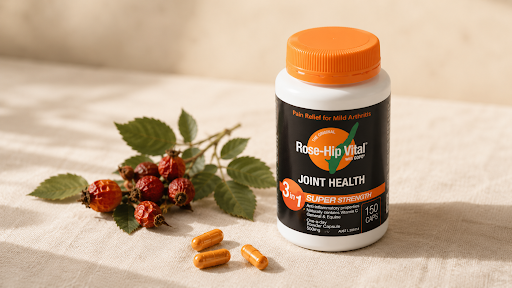
Rosehip has a documented clinical record, one built over decades rather than assembled for a product launch. What separates Rose-Hip Vital from other rosehip products is GOPO®, a patented galactolipid produced during a specific low-heat drying process. No other rosehip supplement contains it. The evidence is substantial:
- 30+ scientific studies on rosehip and GOPO®
- 9 double-blind, placebo-controlled trials, held to the same standard applied to pharmaceutical drugs
- Studies show reduced joint pain, improved mobility, and decreased reliance on NSAIDs
- Results published in peer-reviewed journals including Osteoarthritis and Cartilage
The mechanism is precise: GOPO® blocks white blood cell accumulation around joints, addressing inflammation at the source rather than masking symptoms. That distinction matters when you’re evaluating whether something will actually work.
Glucosamine vs. Rosehip: Side by Side
The studies don’t rule out glucosamine entirely. They show the evidence for rosehip is considerably stronger. Here’s how the two compare on the metrics that matter:
- Mechanism: Glucosamine targets cartilage synthesis / Rosehip (GOPO®) targets inflammation directly
- Evidence quality: Glucosamine yielded 1 major RCT with mixed results / Rosehip is backed by 9 placebo-controlled trials with consistent outcomes
- Side effects: Glucosamine is sourced from shellfish (potential allergy risk) / Rosehip is plant-based and well-tolerated
- Onset: Glucosamine typically requires 3 to 6 months with uncertain results / Rosehip studies show measurable improvement in 3 to 4 weeks
- Nutritional profile: Glucosamine is a single isolated compound / Rosehip includes natural vitamin C, antioxidants, and omega fatty acids
When the clinical record is this one-sided, the choice becomes straightforward.
The Research Has Done The Work. Now It’s Your Turn.
If glucosamine hasn’t worked for you, you weren’t making a bad decision. You were making one without the full picture. The clinical standard matters, and not every supplement meets it. Rosehip, backed by 30+ studies and 9 placebo-controlled trials, does.